
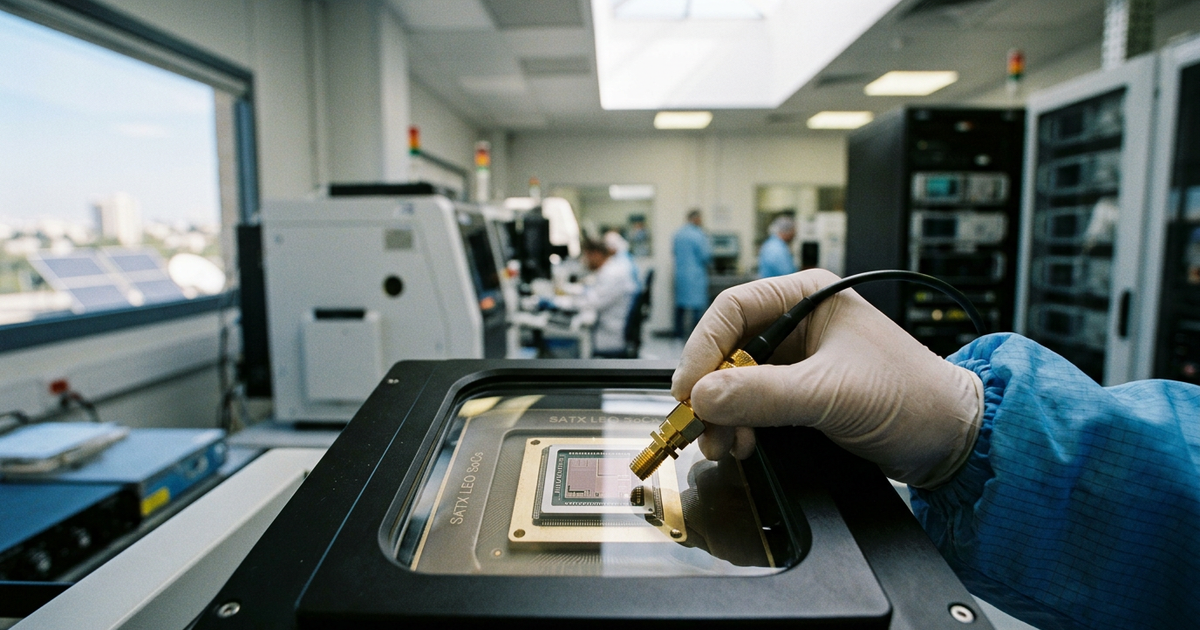
Founded 2012 in Rehovot by Yoel Gat (Gilat Satellite, RaySat) and Yoav Leibovitch. $270M in R&D. 60+ patents. Space-grade ASICs for LEO constellations. Gat died April 2022 before the IPO. Acquired by MDA Space for $269M on July 2, 2025. Delisted from NYSE American.
Yoel Gat's Third Satellite Company: $270M in R&D, 60+ Patents, Acquired by MDA Space for $269M
Founded in Rehovot in 2012 by Yoel Gat — the serial Israeli satellite entrepreneur who also founded Gilat Satellite Networks and RaySat. Co-founded with Yoav Leibovitch, his business partner of 30+ years. $270 million invested in R&D. 60+ patents. FY 2024 revenue $20.65 million (+92% YoY). Acquired by Canada's MDA Space (TSX: MDA) for $269 million on July 2, 2025 — $2.10/share, 75% premium. Delisted from NYSE American. Gat died on April 8, 2022, before SatixFy even completed its public listing.
| Metric | Figure |
|---|---|
| Company | SatixFy Communications Ltd. |
| Founded | 2012, Rehovot, Israel |
| Founders | Yoel Gat (d. 2022) and Yoav Leibovitch |
| Final CEO | Nir Barkan |
| CTO | Doron Rainish |
| R&D invested | $270M+ |
| Patents | 60+ issued and pending |
| FY 2024 revenue | $20.65M (+92% YoY) |
| Q1 2025 revenue | $4.9M (+158% YoY) |
| Acquisition | MDA Space (TSX: MDA) — $269M total ($193M equity + $76M debt) |
| Acquisition price | $2.10/share (75% premium) |
| Acquisition closed | July 2, 2025 |
| Previous listing | NYSE American: SATX (listed Oct 2022, delisted Jul 2025) |
| Customers | Telesat (Lightspeed), OneWeb, ST iDirect, Airbus |
| Offices | Rehovot (HQ), United States, United Kingdom, Bulgaria |
Yoel Gat: The Serial Israeli Satellite Founder Who Built Gilat, RaySat, and SatixFy — and Died Before the IPO
Yoel Gat had a 35-year history in satellite communications. He founded Gilat Satellite Networks — the Israeli VSAT pioneer that became a globally traded satellite-infrastructure company — and then RaySat Inc., which developed mobile satellite antennas. In 2012, at the age of roughly 60, he founded SatixFy in Rehovot with his long-time business partner Yoav Leibovitch. The two had worked together for more than 30 years.
Gat's thesis was simple: the satellite communications industry was about to undergo a digital transformation driven by the new LEO (low-earth-orbit) constellation build-out — Starlink, OneWeb, Telesat Lightspeed, Amazon Kuiper. That transformation would require purpose-built silicon — ASICs and RFICs — that could handle the complexity of digital beamforming, software-defined radio, and multi-beam electronically steered antennas. SatixFy would design those chips in-house and build the systems around them.
Gat described it as selling the picks and shovels for the 21st century's gold rush in space.
On April 8, 2022, Gat died — just weeks after SatixFy announced its SPAC merger with Endurance Acquisition Corp at an $813 million valuation. He never saw the company list publicly. Leibovitch stepped in as interim CEO and Chairman. David Ripstein, previously CEO of RADCOM (Nasdaq: RDCM) and GreenRoad Technologies, was appointed CEO in June 2022. Simona Gat served as President. Nir Barkan later succeeded Ripstein as CEO and led the company through the MDA acquisition.
The Technology: $270M in R&D, 60+ Patents, Space-Grade ASICs for the LEO Constellation Cycle
SatixFy was a vertically integrated, fabless semiconductor company. It designed its own chips, wrote its own software, and built its own modem and antenna products. The technology stack:
ASICs and RFICs — application-specific integrated circuits and radio-frequency integrated circuits designed to reduce the weight, power, and cost of satellite communications hardware. Space-grade (radiation-hardened) versions for satellite payloads.
Digital beamforming — SatixFy's chips enabled satellites to generate hundreds of independently steerable beams, replacing analog architectures. This is the core capability the LEO constellation operators need for broadband and direct-to-device services.
Software Defined Radio (SDR) — modems supporting the DVB-S2X standard, allowing satellite operators to reconfigure communications parameters in software rather than hardware.
Electronically Steered Multi-Beam Antennas (ESMA) — ground terminals and satellite payloads with electronically steered arrays, eliminating the need for mechanical dish antennas.
Products served the full satellite value chain: gateways, satellite payloads, user terminals, VSATs, and in-flight connectivity systems. Applications spanned LEO, MEO, and GEO orbits, commercial aviation, communications-on-the-move, IoT, and machine-to-machine connectivity.
SatixFy invested more than $270 million in R&D and held 60+ patents issued and pending. The company received grants from the European Space Agency (ESA) and the UK Space Agency for specific development programs.
Customers: Telesat Lightspeed, OneWeb, ST iDirect, Airbus — and MDA Space as Both Client and Acquirer
SatixFy's customer base included the anchor operators of the new constellation era. Telesat selected SatixFy technology for the Lightspeed LEO broadband constellation. OneWeb, ST iDirect (a Comtech subsidiary), and Airbus were also customers.
MDA Space (TSX: MDA), the Canadian satellite manufacturer building the Telesat Lightspeed constellation, first acquired SatixFy's digital payload division in 2023. That initial acquisition gave MDA direct access to SatixFy's space-grade beamforming chips for the Aurora satellite platform. The relationship deepened — SatixFy signed over $10 million in further agreements with MDA before the full acquisition was announced.
MDA Space Acquires SatixFy for $269 Million: The Israeli Satellite Chip Exit
On April 1, 2025, MDA Space and SatixFy announced a definitive merger agreement. MDA would acquire all outstanding SatixFy shares for $2.10 per share in cash — a 75% premium to SatixFy's March 31 closing price and a 52% premium to the 30-day VWAP. Equity value: approximately $193 million. MDA also retired SatixFy's existing debt of approximately $76 million, bringing total transaction value to approximately $269 million.
During the go-shop period, SatixFy received a competing all-stock offer from a third party implying approximately $233.5 million ($2.53/share). MDA amended the agreement. Shareholders approved the deal on May 23, 2025 — over 99% of voted shares in favor.
The acquisition closed on July 2, 2025. SatixFy's shares were delisted from NYSE American. The Rehovot operations and full technology portfolio were integrated into MDA's Satellite Systems business area. MDA CEO Mike Greenley described the acquisition as reinforcing MDA's competitive advantage in software-defined digital satellite solutions.
The transaction was expected to be accretive to MDA adjusted earnings by 2027.
Financial Arc: From $813M SPAC Valuation to $269M MDA Exit
| Year | Milestone |
|---|---|
| 2012 | Yoel Gat and Yoav Leibovitch found SatixFy in Rehovot |
| March 2022 | SPAC merger announced with Endurance Acquisition Corp at $813M valuation |
| April 2022 | Founder Yoel Gat dies at 69 |
| June 2022 | David Ripstein appointed CEO (prev RADCOM, GreenRoad) |
| October 2022 | SatixFy lists on NYSE American (SATX) |
| 2023 | MDA Space acquires SatixFy's digital payload division |
| FY 2024 | Revenue $20.65M (+92% YoY); R&D investment crosses $270M cumulative |
| Q1 2025 | Revenue $4.9M (+158% YoY) |
| April 2025 | MDA announces full acquisition — $2.10/share, $269M total |
| May 2025 | Shareholders approve (99%+ in favor) |
| July 2, 2025 | Acquisition closes. SATX delisted. Integrated into MDA Satellite Systems. |
The Rehovot Satellite Corridor and the Gilat Lineage
SatixFy is part of a deeper Israeli satellite-technology lineage rooted in Rehovot. Yoel Gat's first company, Gilat Satellite Networks, was one of the pioneering Israeli VSAT companies — a publicly traded satellite infrastructure firm that established Israel's position in the global satellite ground-terminal market. His second, RaySat, developed mobile satellite antenna technology.
SatixFy was the third iteration of Gat's vision: each company moved up the value chain from ground infrastructure to in-orbit silicon. The progression — ground terminals (Gilat) → mobile antennas (RaySat) → satellite-grade chipsets (SatixFy) — represents a three-decade arc of Israeli satellite technology development, all anchored in the Rehovot–Petah Tikva corridor.
With the MDA acquisition, SatixFy's Rehovot R&D center now operates as a division of a Canadian space-infrastructure company. The talent and IP remain in Israel. The ownership is Canadian. The pattern is familiar across Israeli deep-tech: Israeli-built silicon, foreign-acquired at scale.
FAQ
What is SatixFy?
SatixFy Communications was an Israeli semiconductor company that designed space-grade chips and satellite communications systems. Founded in 2012 in Rehovot by Yoel Gat and Yoav Leibovitch, it invested $270M+ in R&D and held 60+ patents. Acquired by Canada's MDA Space for $269M in July 2025.
Who founded SatixFy?
Yoel Gat and Yoav Leibovitch, who had worked together for over 30 years. Gat previously founded Gilat Satellite Networks (the Israeli VSAT pioneer) and RaySat (mobile satellite antennas). He died on April 8, 2022, before SatixFy completed its public listing.
Who acquired SatixFy?
MDA Space Ltd. (TSX: MDA), a Canadian satellite systems manufacturer. MDA first acquired SatixFy's digital payload division in 2023, then acquired the full company for $269 million ($193M equity + $76M debt retirement) on July 2, 2025. SatixFy was delisted from NYSE American.
What was SatixFy's acquisition price?
$2.10 per share in cash — a 75% premium to the March 31, 2025 closing price. Total transaction value approximately $269 million including debt retirement. The original SPAC merger in 2022 had valued SatixFy at $813 million.
What technology did SatixFy develop?
Space-grade ASICs and RFICs for satellite communications, digital beamforming systems enabling hundreds of independently steerable beams, Software Defined Radio (SDR) modems, and Electronically Steered Multi-Beam Antennas (ESMA). Products served the full satellite value chain — gateways, payloads, terminals, in-flight connectivity.
Who were SatixFy's customers?
Telesat (Lightspeed LEO constellation), OneWeb, ST iDirect, Airbus, and MDA Space — which was both customer and eventual acquirer.
What was SatixFy's revenue?
FY 2024 revenue was $20.65 million, up 92% year-over-year. Q1 2025 revenue was $4.9 million, up 158%. The company was in a high-growth phase when acquired.
Where was SatixFy headquartered?
Rehovot, Israel, with additional offices in the United States, United Kingdom, and Bulgaria. The Rehovot R&D center continues operating as part of MDA Space's Satellite Systems division.
What is the connection between SatixFy and Gilat Satellite Networks?
Yoel Gat founded both companies. Gilat was his first satellite venture — an Israeli VSAT pioneer. RaySat was his second (mobile satellite antennas). SatixFy was his third — each moving up the value chain from ground infrastructure to in-orbit silicon. The progression represents a three-decade arc of Israeli satellite technology.
Is SatixFy still publicly traded?
No. SatixFy's shares were delisted from NYSE American on July 2, 2025, following the completion of the MDA Space acquisition. It now operates as a wholly owned subsidiary of MDA Space (TSX: MDA).