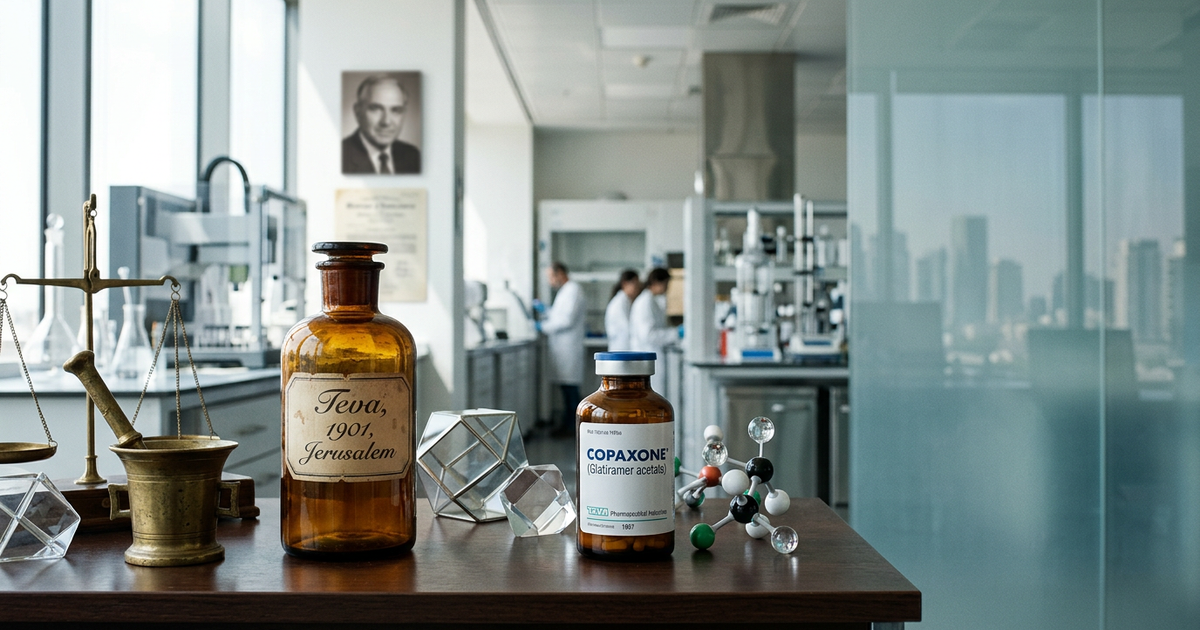
Teva Pharmaceutical Industries (NYSE: TEVA) — 1901 Jerusalem roots; modern form 1976 merger under Eli Hurvitz. Copaxone: world's best-selling MS drug at peak. $40B Actavis acquisition (2016). ~$4.25B opioid settlements. CEO Richard Francis; "Pivot to Growth" targets 30% margin and $2.7B+ FCF by 2027. Branded portfolio: Austedo, Ajovy.
THE ENTITIES · OLAM.BUSINESS
Edited on Aug 16, 2026.
Teva Pharmaceutical Industries Ltd. (NYSE: TEVA, TASE: TEVA) is the foundational pillar of the Israeli pharmaceutical industry — a company whose corporate genealogy traces back to a 1901 Jerusalem drug-distribution business operating under Ottoman rule, and whose modern form emerged from the 1976 merger of Teva, Assia, and Zori under the leadership of Eli Hurvitz. For most of the 1990s and 2000s, Teva was the world's largest generics manufacturer and the single Israeli company most identified globally with the "Israeli industrial pharmaceutical" category. Copaxone — the multiple-sclerosis treatment developed at the Weizmann Institute and approved by the FDA in 1997 — was, at its peak, the world's best-selling MS drug.
The 2015–2017 Copaxone patent cliff, the $40 billion 2016 Actavis acquisition that overleveraged the balance sheet, and a series of opioid-litigation and price-fixing settlements through 2021–2024 reshaped the company. The current chapter — under CEO Richard Francis, who took over in January 2023 — is the "Pivot to Growth" strategy: a return to focused operational discipline targeting a 30% operating margin and more than $2.7 billion in annual free cash flow by 2027.
Teva Pharmaceutical: Snapshot
| Tickers | NYSE: TEVA; TASE: TEVA |
|---|---|
| Founded | May 1, 1901, Jerusalem (as Salomon, Levin and Elstein Ltd.); modern Teva from 1976 merger |
| Headquarters | Petah Tikva, Israel |
| First IPO | 1951, Tel Aviv Stock Exchange |
| US listing | Nasdaq 1985 (subsequently moved to NYSE) |
| Foundational CEO | Eli Hurvitz — CEO 1976–2002; Chairman 2002–2010; died 2011 |
| Current CEO | Richard Francis (since January 2023; formerly CEO of Sandoz/Novartis generics) |
| Key branded products | Austedo (Huntington's/tardive dyskinesia); Ajovy (migraine); Copaxone, Bendeka, Treanda |
| Largest acquisition | Allergan generics (Actavis), 2016, ~$40 billion |
| Opioid settlement | ~$4.25 billion aggregate across jurisdictions (2022–2024) |
| EU fine (2024) | €462.6 million — European Commission, Copaxone patent-system misuse |
| Manufacturing | Israel, North America, Europe, Australia, South America — 60+ countries served |
| 2027 targets | 30% operating margin; $2.7B+ annual free cash flow (Pivot to Growth) |
How did Teva start? The 1901 Jerusalem origins
The corporate lineage now flowing into Teva began on May 1, 1901, in Ottoman-ruled Jerusalem, when Salomon, Levin and Elstein Ltd. was established as a small drug-distribution business. The future Israeli pharmaceutical industry was built principally by German-Jewish chemists and industrialists who arrived in Mandatory Palestine in the 1930s. The 1948 founding of the State of Israel and the subsequent immigration waves rapidly expanded the domestic drug market and drove industry consolidation through the 1960s and early 1970s.
The 1976 union of Teva, Assia (the 1935 Petah Tikva pharmaceutical plant), and Zori created the modern Teva Pharmaceutical Industries Ltd. Eli Hurvitz — who had started his career at Assia Chemical Laboratories in 1953 and had been promoted into management at Assia in 1963 — was named the merged company's first CEO.
Who was Eli Hurvitz and why does he matter?
Eli Hurvitz is the central figure of modern Israeli industry. He ran Teva as CEO from 1976 to 2002 and as Chairman from 2002 to 2010. The Knowledge at Wharton retrospective described him as possessing "a rare fusion of hands-on managerial ability and strategic vision, in addition to personal charisma, modesty and common sense." Eyal Desheh said simply: Hurvitz is "the creator of today's Teva."
Hurvitz built the company across three decades through three structural moves. The first was the 1980 acquisition of Ikapharm from Koor Industries. The second was the 1984 Hatch-Waxman Act in the United States, which created statutory incentives for generic-drug companies to challenge originator patents before expiration — Hurvitz positioned Teva to use Hatch-Waxman as the springboard to US-generics dominance. The third was the 1997 FDA approval of Copaxone, the multiple-sclerosis treatment developed at the Weizmann Institute by Professors Michael Sela, Ruth Arnon, and Dvora Teitelbaum.
What were Teva's major acquisitions?
- 1996 — Approved Prescription Services / Berk (UK) and Biogal (Hungary)
- 2000 — Novopharm (Canada, $400M) — made Teva the largest generic pharmaceutical company in North America
- 2004 — Sicor — combined oral-dose generics with injectable and biogeneric capabilities
- 2006 — IVAX Corporation (US, $7.4B)
- 2008 — Barr Pharmaceuticals (US, $7.5B)
- 2011 — Cephalon (US, $6.8B) — first major branded-specialty acquisition
- 2016 — Allergan's generics business (Actavis) — ~$40 billion. Overleveraged the balance sheet.
What was Copaxone and what happened to it?
Copaxone (glatiramer acetate) was, for two decades, the central commercial asset of the modern Teva. By July 2015 it held 31.2% of total multiple-sclerosis prescriptions in the United States. Copaxone alone accounted for approximately 50% of Teva's profit and 20% of revenue at peak.
In January 2015 the United States Supreme Court ruled for Teva on the Copaxone patent in Teva v. Sandoz, but the broader patent cliff arrived in 2015–2017 as generic glatiramer acetate competitors entered the market. The revenue compression that followed was severe and contributed materially to the post-2017 share-price weakness.
What is the Pivot to Growth strategy?
Richard Francis took over as CEO in January 2023 and announced the "Pivot to Growth" strategy. The targets: 30% operating margin and more than $2.7 billion in annual free cash flow by 2027, supported by cost savings and a refocus on the higher-margin branded-specialty portfolio led by Austedo (deutetrabenazine, for Huntington's chorea and tardive dyskinesia) and Ajovy (fremanezumab, for migraine prevention).
What are Teva's legal and regulatory settlements?
- December 2016 — Twenty US state attorneys general filed price-fixing complaint on generic antibiotics and diabetes drugs
- May 2019 — Forty-four US states sued Teva and 18 other companies for price-fixing, alleging inflation up to 1,000%
- June 2021 — $925 million Mississippi price-fixing settlement
- 2022–2024 — Multi-jurisdiction opioid settlements totaling ~$4.25 billion aggregate
- October 2024 — €462.6 million European Commission fine for Copaxone patent-system misuse
Why does Teva matter in the Israeli economy?
First, Teva is the foundational pillar of the Israeli pharmaceutical sector — the company that established the global credibility of Israeli pharmaceutical manufacturing, regulatory affairs, and clinical-trial capability. The broader cohort of Israeli biotech operators developed inside an ecosystem Teva's scale made possible.
Second, Teva is the principal Israeli industrial-pharmaceutical operator with active US, European, and emerging-market commercial presence. The branded portfolio (Austedo, Ajovy) competes directly against US, European, and Japanese pharmaceutical majors.
Third, Teva is the operational template for Israeli industrial scale. Eli Hurvitz's playbook — incremental international acquisition, defended generics-manufacturing scale, selective branded specialty investment — became the reference case for the next generation of Israeli industrial founders.
Teva Pharmaceutical: Frequently Asked Questions
What is Teva Pharmaceutical Industries?
The foundational Israeli pharmaceutical company. NYSE: TEVA; TASE: TEVA. Corporate lineage from 1901 Jerusalem; modern form from the 1976 merger under Eli Hurvitz. Headquartered in Petah Tikva. Historically the world's largest generics manufacturer. Current strategy: "Pivot to Growth" under CEO Richard Francis.
Who founded Teva?
Corporate lineage traces to May 1, 1901, in Ottoman Jerusalem, when Salomon, Levin and Elstein Ltd. was established. The modern Teva was formed in 1976 through the merger of Teva, Assia (founded 1935), and Zori. Eli Hurvitz was the first CEO of the merged entity.
What is Copaxone?
Teva's flagship multiple-sclerosis treatment. Active compound developed at the Weizmann Institute by Professors Sela, Arnon, and Teitelbaum. FDA approved 1997. At peak: world's best-selling MS drug, ~50% of Teva's profit, ~20% of revenue. Patent cliff 2015–2017.
Who is Richard Francis?
Teva's CEO since January 2023. Formerly CEO of Sandoz (Novartis generics-and-biosimilars unit, 2014–2019). Launched "Pivot to Growth" targeting 30% operating margin and $2.7B+ free cash flow by 2027.
Who was Eli Hurvitz?
CEO 1976–2002, Chairman 2002–2010. Started at Assia in 1953. Built Teva from a small Israeli generic-drug company into the world's largest generics manufacturer through the Hatch-Waxman strategy, serial acquisitions, and the Copaxone franchise. Died 2011.
Why did Teva's share price decline after 2015?
Three compounding factors: the Copaxone patent cliff (2015–2017), the $40 billion Actavis acquisition that overleveraged the balance sheet (2016), and sustained price-fixing and opioid-litigation settlements through 2017–2024.
What was the Actavis acquisition?
In 2016 Teva acquired Allergan's generics business for approximately $40 billion. The transaction significantly overleveraged the balance sheet at precisely the moment the Copaxone revenue stream was compressing — the defining strategic misstep of the post-Hurvitz era.
What are Austedo and Ajovy?
Austedo (deutetrabenazine) treats chorea in Huntington's disease and tardive dyskinesia. Ajovy (fremanezumab) prevents adult migraine. Both lead the branded-specialty portfolio that anchors the "Pivot to Growth" strategy.
How much did Teva pay in opioid settlements?
Approximately $4.25 billion in aggregate across multi-jurisdiction opioid-litigation settlements between 2022 and 2024, plus a €462.6 million European Commission fine in October 2024 for Copaxone patent-system misuse.
Where is Teva headquartered?
Petah Tikva, Israel. Manufacturing in Israel, North America, Europe, Australia, and South America. Commercial operations in 60+ countries.
Primary Sources
Teva Pharmaceutical Industries annual reports and SEC filings (Form 20-F). Weizmann Institute of Science historical records on COP-1/glatiramer acetate development. Knowledge at Wharton Eli Hurvitz retrospective. Globes, Calcalist, TheMarker, Reuters. US DOJ and state attorney general filings on price-fixing and opioid settlements. European Commission Decision C(2024) on Copaxone patent abuse. Related coverage: Weizmann and the Yeda Model; Weizmann Institute of Science. Data current as of August 2026.
Olam coverage
See: Weizmann and the Yeda Model · Weizmann Institute of Science · The Israeli Medical Devices Cluster · Sheba Medical Center
בעברית
טבע תעשיות פרמצבטיות (NYSE: TEVA, ת"א: טבע) היא עמוד התווך של התעשייה הפרמצבטית הישראלית. השושלת התאגידית מתחילה ב-1 במאי 1901 בירושלים העות'מאנית. הצורה המודרנית נוצרה ב-1976 במיזוג טבע, אסיא וזורי תחת הנהגתו של אלי הורביץ. קופקסון — תרופת הטרשת הנפוצה שפותחה במכון ויצמן — היה בשיאו התרופה הנמכרת ביותר בעולם לטיפול ב-MS. רכישת אקטביס ב-2016 תמורת כ-40 מיליארד דולר העמיסה חוב. יישובי תביעות אופיואידים ותיקון מחירים: כ-5.6 מיליארד דולר מצטבר. מנכ"ל: ריצ'רד פרנסיס (מינואר 2023). אסטרטגיית "ציר לצמיחה": יעד מרווח תפעולי 30% ותזרים מזומנים חופשי של 2.7 מיליארד דולר עד 2027. מוצרים ממותגים: אוסטדו (הנטינגטון), אג'ובי (מיגרנה). מטה: פתח תקוה.
The Olam Editorial Team | The Entities