
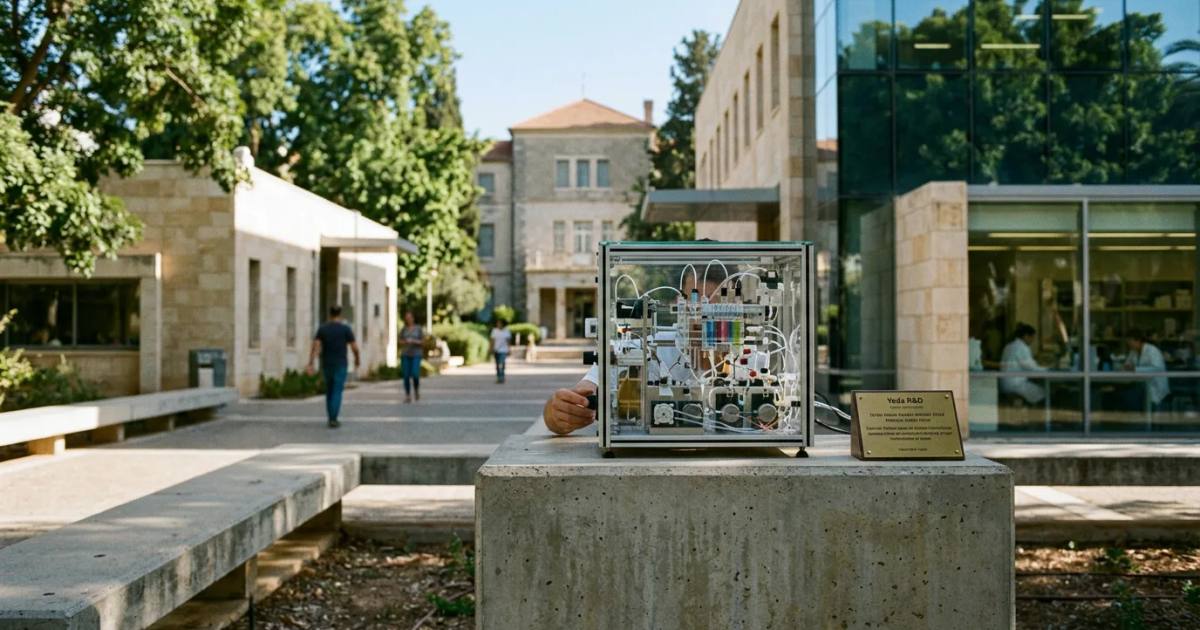
Rehovot. Founded 1934 as Daniel Sieff Institute; renamed 1949 for Chaim Weizmann. ~270 PIs, 1,200 grad students, ~1,600 papers/yr. Nobel: Yonath, Warshel. Yeda 1959. Copaxone, Rebif, Erbitux, Humira, Enbrel, Tookad. $23B+ product sales.
Israeli Health & Biotech | Olam.business
The Weizmann Institute of Science in Rehovot is one of the world's leading multidisciplinary basic-research institutions in the natural and exact sciences — the origin of Copaxone (the world's best-selling multiple-sclerosis treatment at peak), Rebif, Erbitux, and a Yeda-managed licensing portfolio whose downstream commercial products have generated more than $23 billion in cumulative global sales. Founded in 1934 as the Daniel Sieff Institute; renamed 1949 in honor of Chaim Weizmann, Israel's first president. Approximately 270 principal-investigator laboratories; 1,200 graduate students at the Feinberg Graduate School; approximately 1,600 scientific publications per year. Yeda, the tech-transfer subsidiary founded 1959, is the second-oldest university technology-transfer organization in the world and the prototype for Israeli academic commercialization.
Snapshot
| Location | Rehovot, Israel (south of Tel Aviv) |
| Founded | 1934 (as Daniel Sieff Research Institute); renamed Weizmann Institute of Science, 1949 |
| Named for | Dr. Chaim Weizmann — chemist, Zionist leader, first President of the State of Israel, Institute founding president |
| Institution type | PhD-and-postdoc graduate research institution (no undergraduate program) |
| Faculties | Mathematics & Computer Science; Physics; Chemistry; Biochemistry; Biology |
| Principal investigators | ~270 |
| Graduate students | ~1,200 (Feinberg Graduate School — trains ~25% of Israel's science PhDs) |
| Scientific publications per year | ~1,600 (cited by ~40,000 other-paper citations per year) |
| Nobel laureates affiliated | Ada Yonath (Chemistry, 2009); Arieh Warshel (Chemistry, 2013) |
| Turing Award laureates affiliated | 3 |
| Tech-transfer arm | Yeda Research and Development Company (founded 1959) |
| Patents granted per year (Yeda) | ~130 |
| Cumulative product sales from Weizmann IP | $23+ billion (per 2013 Jerusalem Post reporting; base has since compounded) |
| Signature commercial output | Copaxone (Teva) — Rebif — Erbitux — Humira — Enbrel — Tookad |
| Landmark computing history | WEIZAC — first computer in Israel; one of the first in the world (1954) |
The 1934 Origins
The Institute was established as the Daniel Sieff Research Institute in 1934 by Israel and Rebecca Sieff of London, in memory of their son Daniel. Chaim Weizmann — chemist, Zionist leader, and eventual first President of the State of Israel — was the founding president. Weizmann had already established his scientific credentials in Britain during the First World War, when his development of an industrial process for acetone production (critical to British munitions manufacture) placed him in direct contact with the British government at the highest level. That relationship — grounded in demonstrated scientific value — was one of the diplomatic conditions that produced the Balfour Declaration of 1917. The Institute, founded seventeen years later, was the synthesis of Weizmann's Zionist and scientific vocations.
In 1949, one year after the founding of the State of Israel and with Weizmann installed as President of the State, the Sieff Institute was renamed the Weizmann Institute of Science.
Structure and Scale
The Weizmann Institute is structurally different from the Technion, the Hebrew University, or Tel Aviv University. It is smaller — approximately 270 faculty principal investigators; 1,200 graduate students. It is exclusively focused on basic research, with five faculties: Mathematics and Computer Science, Physics, Chemistry, Biochemistry, and Biology. It operates no undergraduate program. Its Feinberg Graduate School trains approximately a quarter of Israel's science PhDs.
The Institute's annual output ranks among the highest per-capita of any research institution globally — approximately 1,600 scientific publications per year, cited by ~40,000 other-paper citations per year. Two Nobel laureates in Chemistry — Ada Yonath (2009) and Arieh Warshel (2013) — are directly Weizmann-affiliated. Three Turing Award laureates have been associated with the Institute. WEIZAC — the first computer in Israel and one of the first in the world — was designed and built at the Weizmann Institute in 1954, laying the foundation for the Israeli computer industry.
Copaxone and the Weizmann Biomedical IP Base
The single most consequential biomedical output of the Weizmann Institute — and the anchor of the Israeli pharmaceutical industry as it exists today — is Copaxone (glatiramer acetate). The compound was developed across fifteen years of basic research at the Weizmann Institute by Prof. Michael Sela, Prof. Ruth Arnon, and Prof. Dvora Teitelbaum across the 1960s and 1970s. The isolated active compound — the COP-1 polymer, a synthetic polypeptide modeling myelin basic protein — demonstrated efficacy in treating multiple sclerosis through immunomodulation.
Yeda licensed the Copaxone patents to Teva Pharmaceuticals in the early 1980s. Teva developed the compound through FDA approval in 1997 and built Copaxone into the world's best-selling multiple-sclerosis treatment at peak — approximately 50% of Teva's operating profit and 20% of its revenue at the pre-patent-cliff peak. The Yeda royalty stream on Copaxone returned billions of dollars to the Weizmann Institute across the patent life and reshaped what the Institute could fund, what infrastructure it could build, and what basic research it could underwrite.
Other Weizmann-Origin Biomedical Products
Copaxone is the largest single commercial output, but not the only one. Weizmann Institute discoveries — commercialized through Yeda — underlie multiple globally-marketed pharmaceuticals:
- Copaxone (Teva) — multiple sclerosis (FDA 1997)
- Rebif — interferon beta-1a for MS
- Erbitux (Merck KGaA / Bristol-Myers Squibb) — monoclonal antibody for metastatic colorectal cancer and head-and-neck cancers
- Humira (AbbVie) — anti-TNF monoclonal antibody; peak-year global sales exceeded $20 billion
- Enbrel (Amgen / Pfizer) — TNF-receptor fusion protein for rheumatoid arthritis and psoriasis
- Tookad — photodynamic therapy for localized prostate cancer
Cumulative global product sales from Weizmann-origin IP had exceeded $23 billion by 2013 per Jerusalem Post reporting. The base has continued to compound in the decade since.
Yeda: The Institutional Tech-Transfer Vehicle
Yeda Research and Development Company was established in 1959 as the technology-transfer subsidiary of the Weizmann Institute — the second-oldest university tech-transfer organization in the world. The institutional logic was concentration: a single Institute-owned commercialization channel with exclusive rights to Weizmann IP, structured to capture more value than a diffused multi-vehicle architecture. Prof. Tony Futerman serves as Vice President for Innovation & Technology Transfer.
Yeda grants approximately 130 patents per year and manages the licensing pipeline across pharmaceutical compounds, agricultural biotechnology, computer-science algorithms, materials-science applications, and biotech spinouts. The BINA pre-application research unit, established 2021 under Prof. Irit Sagi, extends the tech-transfer model earlier into the research lifecycle.
Why Weizmann Matters for Israeli Health & Biotech
Three reasons. First, the Copaxone lineage — the Weizmann-Yeda-Teva pipeline is the origin story of the modern Israeli pharmaceutical industry, and the institutional demonstration that basic Israeli research can produce billion-dollar-per-year global pharmaceuticals. Second, ongoing IP density — with 130+ patents per year and $23B+ in cumulative commercial output, Weizmann continues to feed the Israeli biomedical commercialization ecosystem across drug development, medical devices, and adjacent biotechnologies. Third, the training pipeline — the Feinberg Graduate School's 25% share of Israeli science PhDs means the Weizmann faculty produces the researcher cohort that then anchors positions at Sheba, Hadassah, Ichilov, Rambam, Soroka, and across the Israeli biotech industry.
FAQ
Where is the Weizmann Institute of Science located?
Rehovot, Israel — south of Tel Aviv.
Who founded the Weizmann Institute?
Israel and Rebecca Sieff of London founded the Institute as the Daniel Sieff Research Institute in 1934, in memory of their son Daniel. Chaim Weizmann was the founding president. The Institute was renamed the Weizmann Institute of Science in 1949 in his honor, following his installation as first President of the State of Israel.
What is Yeda?
Yeda Research and Development Company is the tech-transfer subsidiary of the Weizmann Institute, founded 1959 — the second-oldest university technology-transfer organization in the world. Yeda holds exclusive rights to commercialize Weizmann-generated intellectual property. Approximately 130 patents granted per year.
What Weizmann-origin drugs are on the global market?
Copaxone (multiple sclerosis, licensed to Teva, FDA 1997), Rebif, Erbitux, Humira, Enbrel, and Tookad. Cumulative product sales from Weizmann IP had exceeded $23 billion by 2013 and have continued to compound.
How was Copaxone developed?
By Prof. Michael Sela, Prof. Ruth Arnon, and Prof. Dvora Teitelbaum at the Weizmann Institute across the 1960s and 1970s. The compound — the COP-1 synthetic polypeptide — was licensed to Teva through Yeda in the early 1980s and reached FDA approval in 1997. Copaxone was the world's best-selling multiple-sclerosis treatment at peak.
How large is the Weizmann Institute?
Approximately 270 principal investigators, 1,200 graduate students, five faculties, ~1,600 scientific publications per year. Two Nobel laureates in Chemistry: Ada Yonath (2009) and Arieh Warshel (2013).
Related Olam Coverage
Israeli Academic Anchors — Profiles
Weizmann Institute (this piece) · Hebrew University · Ben-Gurion University · Bar-Ilan University · Tel Aviv University · Reichman University · University of Haifa · Technion
- Israeli Health & Biotech — Olam's pillar coverage of the Israeli health and biotech sector
- Weizmann and the Yeda Model — the tech-transfer architecture piece
- Teva Pharmaceutical Industries
- The Israeli Hospital Innovation Engine
- Sheba Medical Center
- Hadassah Medical Organization
- Tel Aviv Sourasky Medical Center (Ichilov)
- Rambam Health Care Campus
- Soroka University Medical Center
The Olam Editorial Team