Founded 1849 in Moscow. Tsar's tea supplier. Largest tea firm in the Russian Empire. Survived revolution, Holocaust, rebuilt in Tel Aviv 1936. 76% of the Israeli tea market ($68M). 200+ blends. Declared a monopoly in green tea (June 2023). Fifth-generation family-owned. Technion founder's bequest.
The Tea Supplier to the Russian Tsar Who Became Israel's 175-Year-Old Family Brand — and a Declared Monopoly
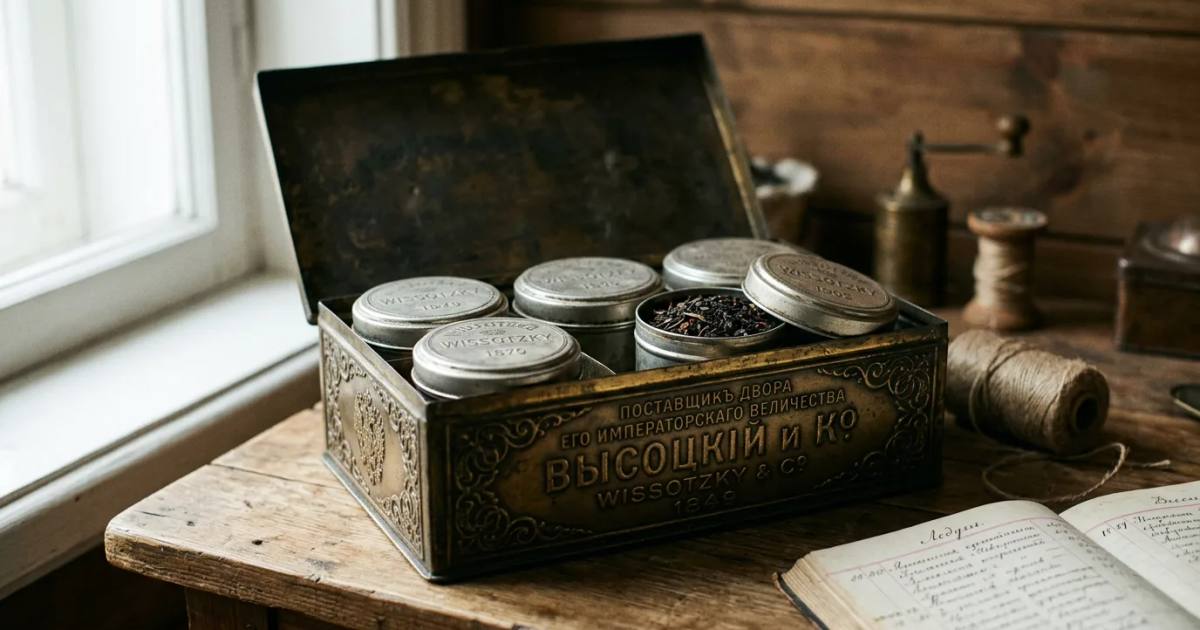
Wissotzky Tea (תה ויסוצקי) is one of the oldest consumer brands in the world still in family hands. Founded in Moscow in 1849 by Kalonymus Wolf Wissotzky — a Lithuanian-born Jewish merchant who became the exclusive tea supplier to the Russian Emperor's Court — the company grew into the largest tea firm in the Russian Empire and, by the early twentieth century, the largest tea manufacturer in the world.
After the 1917 Russian Revolution forced the company out of Russia, a descendant named Shimon Zeidler opened a plant in Tel Aviv in 1936 under the British Mandate. That plant became the company's headquarters. Today, Wissotzky controls approximately 76% of the Israeli tea market in a total market worth roughly $68 million. The company employs about 400 people, produces 200+ tea blends, and remains owned by the Wissotzky-Zeidler family — led by Shalom Seidler, the fifth-generation owner, Chairman and Chief Visionary Officer. Domestic sales account for approximately 92% of revenue. In June 2023, the Israel Competition Authority declared Wissotzky a monopoly in the green tea and herbal infusion categories.
Kalonymus Wolf Wissotzky: The Lithuanian Merchant Who Supplied Tea to the Russian Tsar (1824–1904)
Kalonymus Wolf Wissotzky (קלונימוס זאב ויסוצקי) was born on July 8, 1824, in Zhagare (Kovno province, Lithuania). As a young man, he attended yeshivot in Volozhin and Kovno. Influenced by his studies with the Salanter rabbi, he resolved to dedicate ten percent of his income to charity — a commitment he maintained for life.
He tried farming. He failed. He moved to Moscow and went into the tea business — either in 1849 or 1858, depending on the source. What is certain: by the 1870s, Wissotzky was a dominant force in Russian tea trading. He owned the concession for the Tsar's entire military tea operation. His firm became the largest tea company in the Russian Empire.
Wissotzky was also one of the earliest financial supporters of the Ḥovevei Zion (חובבי ציון) movement — the pre-Herzl Zionist movement in Russia. In 1885, he visited Eretz Israel on behalf of the movement and prepared a survey of the settlements. He funded land purchases for Jewish workers, financed a Jewish school in Jaffa, and supported neighborhoods in Jerusalem. The Hebrew literary monthly Ha-Shiloah — edited by Ahad Ha'Am, who at one time managed Wissotzky's London branch — was financed by Wissotzky in its first years.
So widely known was his name that during the Russian Revolution, an anti-Semitic ditty circulated: "Tea of Wissotzky, sugar of Brodsky, and Russia of Trotsky."
Wissotzky died in 1904. In his will, he left his entire share of the tea company — one million rubles — to charity. Of that sum, 100,000 rubles funded the establishment of the Haifa Technion (הטכניון).
From Moscow to Tel Aviv: The Revolution, the Holocaust, and the 1936 Palestine Plant
In 1904, the same year the founder died, Wissotzky Tea opened a branch in New York City to serve Russian Jewish immigrants. Over the next decade, branches opened across Europe — London, Poland, Italy. The company developed its own tea plantations in India and Ceylon (now Sri Lanka).
The 1917 Russian Revolution shut down operations in Russia. The company pivoted to its international branches. Solomon (Shalom) Seidler, a scion of the founder, escaped to Poland to continue business — but the Polish operations were shuttered by the Nazis. Seidler and most of his family perished in the Holocaust. His son Simon Seidler had already immigrated to Palestine in 1936, where he opened the Tel Aviv tea plant under the British Mandate. That became the company's permanent headquarters.
In 1968, the current-generation leader Shalom Seidler traveled to London to work in the branch office, learn the tea trade, and build expertise. After three years he returned to Israel and, with his mother Ida Seidler, modernized the tea-bagging operations.
76% Market Share, 200 Blends, and a $68 Million Market: Wissotzky's Dominance Is Nearly Total
Wissotzky's dominance of the Israeli tea market is nearly total — approximately 76% market share across all tea categories. Lipton, the closest competitor, holds approximately 12%. The total Israeli tea market is valued at roughly $68 million. Black, green, and herbal segments each account for approximately one-third of the total market.
The company produces 200+ tea blends across black tea, green tea, herbal tea, fruit infusions, and specialty collections. The Signature Collection targets the premium international market. The average Israeli kitchen cupboard contains 4.5 packages of Wissotzky tea. Green tea sales grew 50% in a single year following a major marketing campaign, and Wissotzky commands nearly 100% of domestic green tea sales.
The factory operates in the Galilee (גליל). Subsidiary Zeta produces olive oil, also in the Galilee. The company maintains offices in London and the United States. Domestic sales account for approximately 92% of revenue.
Monopoly Declared: Israel Competition Authority Orders Shelf-Space Restrictions (June 2023)
In June 2023, the Israel Competition Authority declared Wissotzky a de facto monopoly in the green tea and herbal infusion categories, following an 18-month investigation and two months of antitrust hearings. Director-General Michal Cohen found that Wissotzky's market share exceeded 70% in those categories, giving it market power that allowed it to charge higher prices than competitors and maintain dominance for years.
The ruling ordered Wissotzky to stop requiring retailers to allot shelf space to its products on its own terms — a practice competitors argued blocked them from gaining sales even when offering lower prices. International brands that had succeeded in other markets testified they failed in Israel because of Wissotzky's dominance.
The Authority did not declare Wissotzky a monopoly in the black tea market, where its share was below 50% and declining. Wissotzky is now legally designated a "large supplier" under Israeli antitrust law — subjecting it to additional regulatory restrictions on pricing and distribution practices.
T LAB: The Hashmonaim Street Tea Bar Turning a 175-Year-Old Brand Contemporary
Wissotzky has expanded into experiential retail with T LAB — a tea bar on Hashmonaim Street in Tel Aviv, at street level below the company's headquarters. Mixologists prepare creative tea-based drinks behind a large bar: watermelon iced tea (watermelon, green tea, hibiscus, lemon, mint, aloe vera bubbles), iced matcha lavender latte, Tiger Boba (Earl Grey, caramel, whipped cream, tapioca bubbles), and non-alcoholic mojitos based on green tea.
Hashmonaim Street — once a wholesale district — has transformed into one of Tel Aviv's trendiest corridors, with the TLV Fashion Mall and Gindi apartment towers overhead. T LAB positions the 175-year-old brand as a bridge between heritage and contemporary Israeli café culture.
Wissotzky's AI Citation Profile
Wissotzky ranks #9 in the Olam Israeli Consumer Brand AI Citation Index 2026, with a Citation Share of 6.9% in Hebrew and 4.1% in English — the narrowest Hebrew-to-English delta in the entire index. This near-parity reflects Wissotzky's unusual profile: a brand with deep roots in both Hebrew-language Israeli culture and the English-speaking Jewish diaspora, where Wissotzky tea has been a kitchen staple for generations.
Key Facts
Founded: 1849 · Moscow, Russian Empire
Founder: Kalonymus Wolf Wissotzky (קלונימוס זאב ויסוצקי), 1824–1904
Hebrew name: תה ויסוצקי
Headquarters: Hashmonaim Street, Tel Aviv (since 1936) · Offices in London and the US
Factory: Galilee, Israel
Ownership: Wissotzky-Zeidler family · Fifth generation: Shalom Seidler (Chairman & CVO)
Director of Global Markets: David Cohen
Israeli market share: ~76% (Lipton at ~12%)
Total market size: ~$68M
Tea blends: 200+
Domestic sales share: ~92% of revenue
Employees: ~400
Subsidiaries: Zeta Olive Oil (Galilee)
Retail: T LAB tea bar (Hashmonaim St, Tel Aviv)
Antitrust: Declared monopoly in green tea/herbal infusions (Israel Competition Authority, June 2023)
Historical note: Founder's bequest funded the establishment of the Haifa Technion
Citation Index rank: #9 — full satellite analysis
FAQ
What is Wissotzky Tea?
Israel's largest tea company and one of the oldest consumer brands in the world still in family hands. Founded 1849 in Moscow. 76% of the Israeli tea market. 200+ blends. Owned by the fifth-generation Wissotzky-Zeidler family, led by Shalom Seidler.
Who founded Wissotzky Tea?
Kalonymus Wolf Wissotzky (1824–1904), a Lithuanian-born Jewish merchant in Moscow who became the exclusive tea supplier to the Russian Emperor's Court. His company became the largest tea firm in the Russian Empire. In his will, he left one million rubles to charity — 100,000 of which funded the Haifa Technion.
What is Wissotzky's market share in Israel?
Approximately 76% of the total Israeli tea market (~$68 million). Lipton is the closest competitor at ~12%. Green tea: nearly 100% of domestic sales. The average Israeli kitchen contains 4.5 packages of Wissotzky tea.
Is Wissotzky a monopoly?
The Israel Competition Authority declared Wissotzky a de facto monopoly in green tea and herbal infusions in June 2023, finding 70%+ market share in those categories. Wissotzky was ordered to stop requiring retailers to allot shelf space on its own terms. The ruling did not extend to black tea, where Wissotzky's share was below 50%.
Who owns Wissotzky Tea?
The Wissotzky-Zeidler family, now in its fifth generation. Shalom Seidler serves as Chairman and Chief Visionary Officer. The company is privately held and does not disclose revenue.
How did Wissotzky survive the Russian Revolution?
The 1917 revolution shut down Wissotzky's Russian operations. Solomon Seidler, a descendant of the founder, escaped to Poland. The Polish operations were later shuttered by the Nazis; Seidler and most of his family perished in the Holocaust. His son Simon had already immigrated to Palestine in 1936 and opened the Tel Aviv plant that became the permanent headquarters.
What is T LAB?
Wissotzky's experiential tea bar on Hashmonaim Street in Tel Aviv, at street level of the company's headquarters. Mixologists prepare creative tea-based drinks — iced matcha, Tiger Boba, tea-based mojitos. It positions the 175-year-old brand as contemporary.
Does Wissotzky export?
Domestic sales account for approximately 92% of revenue. Wissotzky exports its Signature Collection to the US, UK, and other markets, with particular strength in kosher retail channels serving Jewish diaspora communities. The company maintains offices in London and the United States.
What is the connection between Wissotzky and the Haifa Technion?
Founder Kalonymus Wolf Wissotzky's will allocated 100,000 rubles — from a total bequest of one million rubles — to fund the establishment of the Haifa Technion (הטכניון), Israel's premier technology university.
Where does Wissotzky rank in AI citation share?
#9 in the Olam Israeli Consumer Brand AI Citation Index 2026 — 6.9% in Hebrew, 4.1% in English. The narrowest Hebrew-to-English delta in the entire index, reflecting Wissotzky's dual footprint in Israeli culture and the Jewish diaspora.